




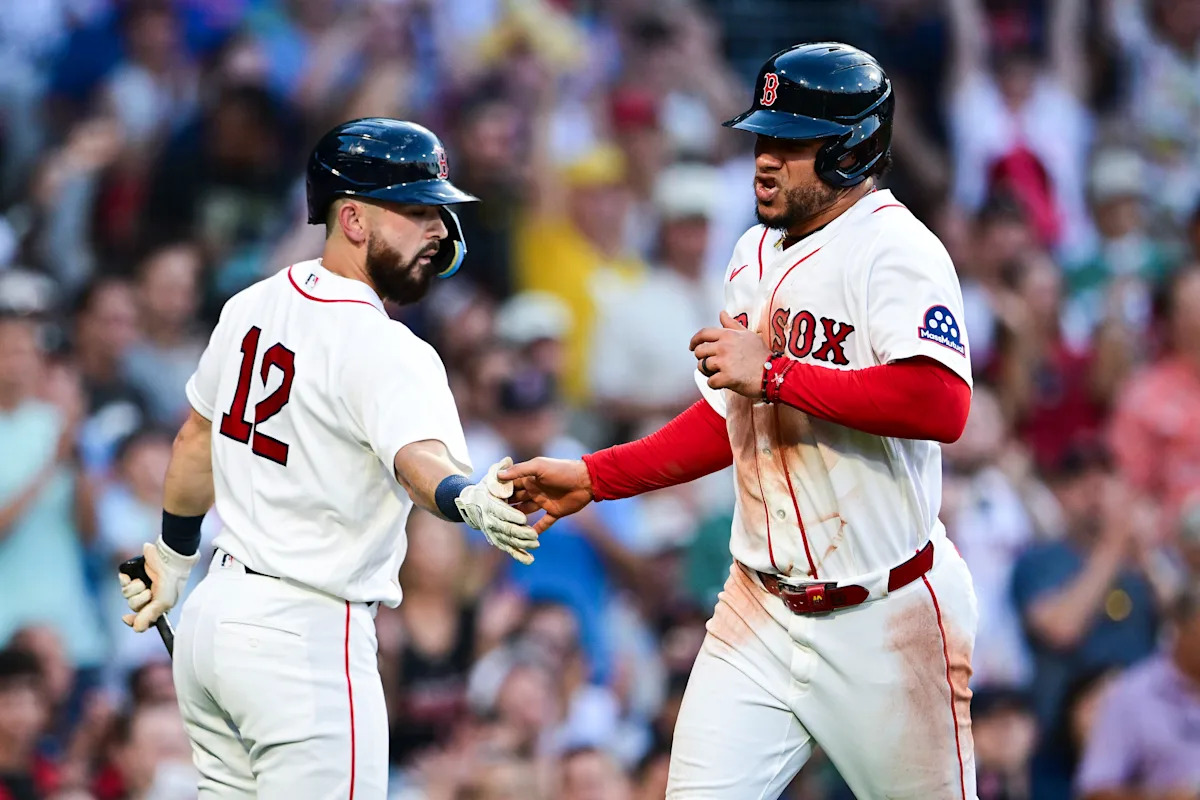
The Red Sox and Orioles came into this week’s series at Fenway Park riding dueling hot streaks, with Baltimore having won a season-high seven straight and Boston rattling off 13 consecutive victories, the franchise’s longest winning streak since 1948. Two AL East clubs that had given their fans little to cheer about over the season’s first two months had suddenly sprung to life to reclaim relevance in an American League light on contenders.
Baltimore and Boston had split the first six games of their season series — the Red Sox took two of three at Camden Yards in late April before the Orioles returned the favor at Fenway Park in early June — which added stakes to this July showdown, as a tiebreaker could prove relevant down the stretch. One final series — a four-game set in Baltimore in early September — remains and could still sway that record, but this week’s series felt like a particularly consequential matchup, especially with the Aug. 3 trade deadline approaching.
Advertisement
Baltimore held a lead for much of Monday’s series opener, but the Red Sox scored in the sixth, seventh and eighth innings to keep their winning streak alive while the Orioles’ was halted. After Tuesday’s game was washed out by rain, a doubleheader Wednesday offered Boston a chance to break the franchise record if they could take both games and sweep the series. Game 1 went swimmingly, as Boston snagged a 4-0 lead in the first inning and cruised to a 6-3 victory, tying the franchise record of 15 consecutive wins set by the 1946 squad (a team that went on to post the second-highest winning percentage in franchise history and lose to the Cardinals in seven games in the World Series).
But the party finally ended in the nightcap for Boston. The Orioles put up four runs in the top of the first inning against rookie left-hander Eduardo Rivera, who didn’t make it out of the frame, and held on from there, taking the series finale 5-1 and salvaging some momentum before heading home to face the Braves this weekend.
Here are five takeaways from this week’s AL East clash.
Boston’s endless supply of southpaws continues to impress
The Red Sox began the season with an unusual abundance of left-handers in their rotation mix. Ace Garrett Crochet had been joined by marquee free-agent addition Ranger Suarez. A pair of promising rookies in Payton Tolle and Connelly Early were preparing to take the next step. Veteran Patrick Sandoval was on his way back from surgery and expected to rejoin the starting staff at some point midsummer.
Advertisement
A bit further down the depth chart was Jake Bennett, an intriguing yet relatively unheralded pitching prospect acquired in December from Washington in exchange for another minor-league arm in Luis Perales. Because Bennett finished last season in Double-A and with a strong showing in the Arizona Fall League, it was reasonable to think he could make his major-league debut with Boston at some point in 2026, though with such a crowded depth chart ahead of him, it was difficult to envision him becoming a crucial part of Boston’s pitching plans anytime soon. Turns out, with injuries interrupting or flat-out derailing the seasons of Crochet, Early and Suarez, Bennett has been pressed into action — and has answered the call in impressive fashion.
In Game 1 of Wednesday’s doubleheader, Bennett completed 5 ⅔ innings with just three earned runs allowed, a solid outing that actually raised his ERA from 2.35 to 2.58 but continued to demonstrate the consistency he has provided to the Red Sox rotation. Bennett does not overwhelm opponents with velocity — though his four-seamer and sinker account for more than 60% of his pitches, they register at 92-93 mph on average — but his excellent changeup induces whiffs and weak contact aplenty. He has notched only 42 strikeouts across his 59 ⅓ innings of work this season but has also surrendered only nine walks, giving him a 3.9% walk rate that is bested only by Tarik Skubal among arms with at least 50 innings pitched.
Pitchers who don’t garner a ton of whiffs tend to need a strong defense behind them for reliable run prevention, and Boston certainly provides that for Bennett, lending confidence that he can continue to be effective. Whether he becomes a rotation fixture or even a candidate to start a postseason game, should Boston reach October, remains to be seen, but what Bennett has already given the Sox after the original rotation plans crumbled has been enormously important.
Two years ago, Henderson put together one of the most impressive seasons we’ve ever seen from a young shortstop. He hit .281/.364/.529 (154 wRC+) with 37 homers and 21 stolen bases, an astonishing level of production for a player at a premium position who turned 23 midway through the season. Although he was outranked on AL MVP ballots by a similarly spectacular shortstop season from Bobby Witt Jr. and the unprecedented pair of Yankees sluggers, Aaron Judge and Juan Soto, Henderson had put himself on the short list of players you’d pick to build your franchise around. The Orioles had drafted and developed a no-doubt perennial MVP candidate for the foreseeable future. Hurrah.
Advertisement
But since that 2024 breakout, Henderson has struggled to recapture his superstar form. Last season was a sizable step back but still a strong campaign by most players’ standards, as Henderson ranked 11th among AL hitters in fWAR (4.8), posting a 120 wRC+ while starting 150 games at shortstop as a 24-year-old. This year, however, has been a downright dud, a shocking regression from his demonstrated MVP-caliber peak that has him bordering on below-average relative to all every-day position players.
Although Henderson has already matched his home run total from last season (17) in more than 50 fewer games, little else about his performance at the plate has trended favorably. Career-low hard-hit and barrel rates, plus a noticeable deterioration in his usually stellar plate discipline, have resulted in a steep decline in overall production. Henderson showed some encouraging signs in the series opener Monday, when he notched the first three-double game of his career, but a 2-for-9 showing in Wednesday’s doubleheader dropped his season OPS to .701, equating to a 95 wRC+. His .296 OBP ranks 129th among 146 qualified hitters.
To dismiss Henderson’s chances of regaining his star status would be foolish. But in a season in which Baltimore added some much-needed veteran support to surround him in the lineup in Pete Alonso and Taylor Ward, his wayward trajectory is as disappointing as it is surprising. Perhaps Henderson, still just 25, finishes strong and quiets some of the concerns, but on a Baltimore club contemplating its direction with the trade deadline arriving soon, such a return to form might be too little too late.
Advertisement
For the first couple months of the season, Durbin’s paltry production was on the list of frustrations for a fan base well acquainted with acrimony. Durbin was acquired from Milwaukee in February as part of Boston’s pivot once Alex Bregman bolted for Chicago, and there was optimism surrounding his arrival coming off his breakout debut campaign that earned him a third-place finish in NL Rookie of the Year voting.
Instead, Durbin got off to a miserable start at the plate, hitting .163/.241/.238 with just one home run in 164 plate appearances across his first 48 games with Boston, amounting to a 32 wRC+ that ranked 170th out of 170 qualified hitters during that span. To make matters worse, the pitcher he was traded for, Kyle Harrison, seemed to be blossoming into an ace in Milwaukee. It was a brutal first impression in every sense.
The Red Sox gave Durbin a few days off to reset at the end of May, and he sought some outside help at a local private hitting facility to get back on track. Since that respite and with some adjustments to his swing focused on his lower half, Durbin has surged with the bat to a shocking degree, going from the bottom of the league’s offensive leaderboards to the upper echelon over the past two months. Since May 28, he ranks among the top 15 qualified hitters in the American League in OPS, and he has climbed out of the 9-hole to become a crucial contributor in the middle of Boston’s lineup, batting no lower than sixth since the calendar flipped to July.
Advertisement
On Monday, Durbin delivered the signature swing of his season, a dramatic, go-ahead blast in the bottom of the eighth inning, sent soaring over the Green Monster to produce mass hysteria at Fenway Park in the best way possible.
If there’s any player who embodies the discouraging lows and delirious highs that this Red Sox season has provided, it’s Durbin. His true talent level is much better than his woeful showing over the first two months and likely not quite as outstanding as his outlier production more recently. But all that matters right now is that Durbin is contributing to a Boston team that has saved its season, affording him opportunities to have more moments like Monday — and that’s pretty darn cool.
Kyle Bradish joins Shane Baz as an Orioles rotation fixture who isn’t going anywhere
Last weekend, the Orioles announced a five-year, $90 million extension for 29-year-old right-hander Kyle Bradish, marking the second long-term pact executed with a starting pitcher following the March deal to ensure that Shane Baz is also in Baltimore for the long haul. Baz and Bradish have formed a steady duo atop the Orioles’ rotation this season, though it hasn’t necessarily translated to a whole lot of winning; the Birds are 6-14 across 20 Baz starts (the latest loss coming Monday) and 10-10 when Bradish gets the ball after his quality start Wednesday night helped snap the Red Sox’s winning streak.
Advertisement
Baz is still trying to maximize the potential that has tantalized since his days as a teenage prospect. Bradish, meanwhile, demonstrated a prolonged stretch of frontline starter performance when he finished fourth in AL Cy Young voting in 2023 but has yet to replicate that level of effectiveness since his return from Tommy John surgery last summer. Along the way, both pitchers have shown flashes of the kind of impact that prompted the team’s long-term investments in them as rotation fixtures for years to come, but there’s undeniably work to be done if Baz and Bradish are to elevate Baltimore’s rotation to that of a legitimate contender.
What should the Red Sox do at the deadline?
The epic winning streak has come to an end, but the effect of this multi-week heater cannot be overstated for the Red Sox. Boston has transformed its season from an embarrassing mess to an enthralling roller coaster of possibilities, seizing on the weak American League to rejuvenate its chances of playing October baseball and reenergizing a fan base that was flat-out furious just a few months ago. And by vaulting up the standings and into a wild-card spot, the Red Sox might have quashed the idea that they could be active sellers ahead of the Aug. 3 trade deadline, a notion initially fueled by the fact that they have several enticing veterans worth targeting had they remained in the AL basement. Instead, the conversation has shifted away from the availability of guys such as Willson Contreras, Sonny Gray and Aroldis Chapman and toward a much different question: Which players should the Red Sox be targeting to improve their roster?
Advertisement
A crowded injured list and varied return timelines for the likes of Crochet and Early on the mound and Roman Anthony, Marcelo Mayer and Trevor Story among the position players make it difficult to identify which holes need to be filled and which could be addressed just by getting healthier. But the Red Sox would be wise to survey the market for help on offense, no matter how much better the bats have been lately in support of All-Star slugger Contreras, who has been raking all year. While Ceddanne Rafaela’s offensive breakout in tandem with his terrific glove has made center field a clear strength, the three other up-the-middle positions have been glaring weak spots: Collectively by wRC+, Boston’s catchers rank 24th, second basemen rank 26th and shortstops rank 27th. Then there’s left fielder Jarren Duran, whose 58 wRC+ is second-lowest among qualified hitters in MLB. All of which is to say: Boston needs another bat or two.
Whether that’s a rental slugger, such as Twins catcher Ryan Jeffers or Giants contact maven Luis Arraez, or a bigger swing for an infielder with more team control, such as Zach Neto, the Red Sox should not be content with their current position-player group if they intend to make a run down the stretch. President of baseball operations Craig Breslow’s hot seat might have cooled off a bit over the past month, but now the pressure ramps up in a different way. And if we’ve learned anything from this Red Sox season, there’s more drama yet to come.
Read the full article here


