




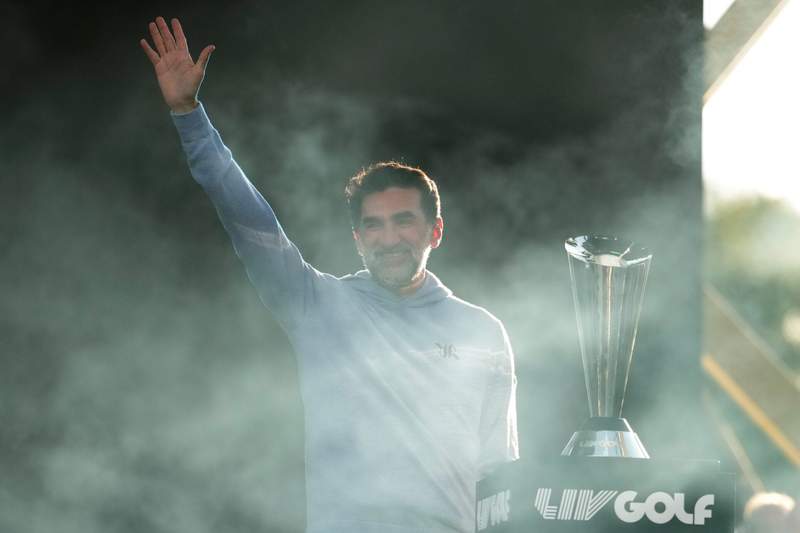
LIV Golf is fighting for its life. Its rescue mission is effectively being led by restructuring experts Alix Partners and the advisory firm Ducera Partners, who are courting fresh investment in the league.
It has been nearly a month since the Public Investment Fund (PIF) confirmed that they were ending their financial support for LIV at the end of the 2026 campaign, which is continuing in Korea this week. Behind the scenes, though, anxieties about the Saudis’ commitment to the project materialised much earlier.
Advertisement
The sovereign wealth trust, which controls nearly a trillion dollars worth of assets, is refocusing its business. Nearly two years ago, PIF governor and former LIV Golf chairman Yasir Al-Rumayyan announced that the group was cutting the proportion of overseas investments it makes from 30 to 20 per cent.
In sports as in infrastructure, media, entertainment and tourism, it is hard to escape the notion that PIF has wildly overpromised in its mission to launder its reputation in the West and diversify the Saudi economy away from oil under Crown Prince Mohamed Bin Salman’s Vision 2030.
In LIV Golf, they have blown about $5bn on unsustainable contracts and prize pots, created a schism with the PGA Tour, left dozens of players in professional limbo and, far from burnishing its image in global sport, have earned a reputation as hucksters.
It’s up to fans to decide whether LIV Golf is worth saving. Some think the product itself is strong, others that it is artificial and hubristic. But it could still live to fight another day.
Photo by Chung Sung-Jun/Getty Images
Chapter 11 bankruptcy, a reorganizational procedure that imposes a temporary halt on creditors calling in their debts and buys a failing company time to get its house in order, is one option.
Advertisement
Alix Partners and Ducera Partners are, though, seeking new capital to the tune of $250-350m.
They have given would-be investors a snapshot of what LIV Golf 2.0 could look like: a leaner, 10-event schedule, equity stakes for players in lieu of outsized contracts, and profitability within three years.
But what kind of individual or institution might take them up on their offer?
Family offices and high net worth investors have been pitched to, but private equity will likely be the biggest player if the rescue investment is secured.
Writing for the Business of Golf, analysis by David Hyland suggests that private equity firms have plunged north of $5.5bn into golf since 2024, through deals to acquire businesses as varied as course operators in Invited Clubs and Concert Golf, the driving range chain Topgolf, and equipment brands LAB Golf.
Advertisement
Private equity sees value in golf’s appreciating real estate and its magnetism for the rich and powerful, but a deal to invest in LIV Golf would likely be structurally different.
Live events, the ticketing ecosystem, media rights, team valuations, sponsorships and merchandise would be the driving forces behind a private equity-backed deal. And the A1 priority for new investors would be getting LIV’s costs under control.
Private equity optimizes and – often ruthlessly – makes companies leaner. It often uses leveraged buyouts to fund its acquisitions, too, which inherently demand a return within a set timeframe.
If private equity does take control at LIV Golf then, expect an altogether less glitzy, much more financially disciplined league, potentially even something that could run in cooperation with the PGA Tour, as was mooted with the ill-fated merger last year. Ultimately, that might be the only pathway to sustainability.
Read more:
Read the full article here


