





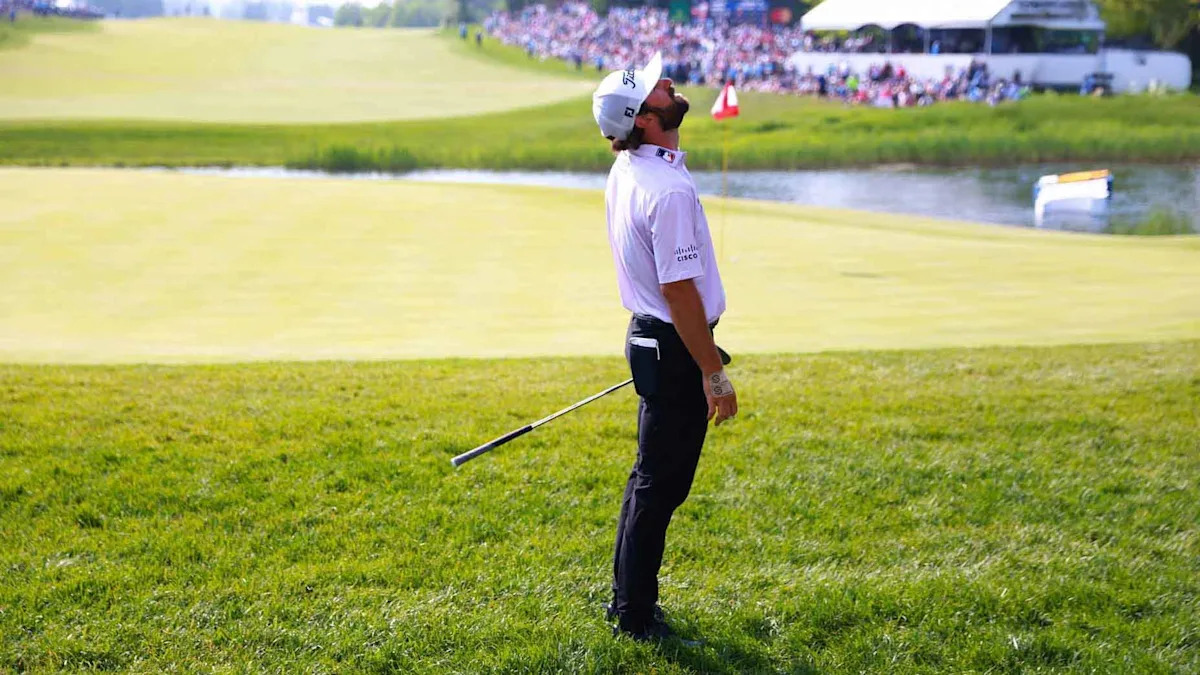
Amateurs have long looked to tour pros as the gold standard for how the game should be played. From swing mechanics to course strategy and even the clubs in their bag, if the best in the world do it, it must be worth copying.
While you can pick up a lot from what the pros do, Cameron McCormick, a GOLF Top 100 Teacher, says that you can learn just as much from what they don’t do.
Advertisement
In a recent Instagram post, McCormick revealed there are three shots he routinely watches amateurs attempt during their rounds that you’ll rarely see pros execute in a tournament.
McCormick said the reason pros avoid specific shots is simple: They are risky. When millions of dollars are on the line, their job is to mitigate risk and play the shot with the best odds. Amateurs, however, often choose the flashier option because they are more focused on proving they can execute it than on understanding what the situation calls for.
“Pros aren’t playing for the highlight reel, they’re playing percentages — and you should, too,” McCormick said.
Below are the three shots McCormick said pros rarely hit — and the shots you should play instead.
The short-sided flop shot
When you find yourself short sided around the green, it can be tempting to try landing a high, soft shot up on the green. But McCormick says it’s a shot tour pros seldom select.
Advertisement
“Pros almost never use this shot because it introduces so much volatility in potential of outcome,” McCormick says, “They’ll only hit that shot when absolutely forced to.”
Rather than risk mis-hitting a short-sided flop shot and sending the ball sailing over the green — or worse, chunking it a few yards in front of you — McCormick says most tour pros opt for a safe, low-running shot.
“They’re going to go with a simple bump and run, using the bank [of the green] to slow the ball down,” he says.
The hero shot
We’re all familiar with this type of shot — you spot a gap in the trees, try to cut a corner or take too much club from an already tricky lie. Essentially, if the shot demands near-perfect execution just to have a chance, it’s a hero shot.
Advertisement
Pros prefer the conservative approach.
“[As a tour pro] I’m going to try and take two shots to get to the green and rely on my short game to get it up and down,” McCormick says.
Playing it safe puts them in position to lean on their short game — a strength for most pros — while avoiding the scramble that follows a failed attempt at the hero shot.
“Make par the hard way, rather than make a double,” McCormick says.
The full swing wedge
According to McCormick, pros avoid full-swing wedges because they’re difficult to control.
“[Hitting a full-swing wedge] introduces the chance they’re going to miss their carry distance, and they potentially could create too much spin — saucing it back off the green,” McCormick says.
Advertisement
“What pros do, is they defer down in their wedge; they’ll go to their next, lowest lofted wedge,” he continues. “And they learn a clock system to where they can control distance, launch angle and spin rate.”
The clock system is a repeatable method that builds feel and consistency. And when you’re as good as the pros, these short, controlled swings allow you to tailor each wedge shot to the specific lie, distance and conditions, which reduces risk and maximizes control.”
The Compression Ball: Golf Impact & Swing Training Aid
The Compression Ball: Golf Impact & Swing Training Aid
The Compression Ball The New Golf Swing Ball Training Aid to Build a Consistent, Connected Motion and Improve Ball Striking Stop the guesswork and start building a powerful, repeatable golf swing. Introducing The Compression Ball, the premier golf impact ball training aid designed to master the most crucial element of a great swing: connection. If you’re tired of inconsistency, this golf swing trainer is your key to synchronizing your arms and body for more accurate strikes and better performance. This impact ball golf trainer is more than just a piece of foam; it’s a comprehensive system for developing muscle memory. Whether you’re a beginner struggling with a “flying elbow” or an experienced player refining your sequence, this is one of the top golf training aids for immediate, tangible feedback. Why The Compression Ball is a Must-Have Piece of Golf Training Equipment: MASTER YOUR CONNECTION: As a leading golf impact ball, its primary function is to keep your arms and body working as one. Place the soft foam ball between your forearms to eliminate separation in your backswing and downswing, leading to dramatically improved ball striking. INNOVATIVE LANYARD SYSTEM: What truly sets this impact ball training aid apart is its adjustable, removable lanyard. When you lose connection during a drill, the ball doesn’t fall to the ground. No more chasing your aid—just uninterrupted, efficient practice. PREMIUM ADAPTIVE FOAM: Made from ultra-soft, durable memory foam that comfortably molds between your arms. We selected the best foam for this training aid—it’s soft enough to prevent tension but firm enough to provide clear feedback on your arm structure. VERSATILE SWING TRAINER: This is the perfect swing trainer golf aid for a wide range of practice. Use it for chipping, pitching, half-swings, and full-swing practice. It’s lightweight and perfect for the range, home, or as part of your pre-round warm-up. Benefits – ✅ Build a Tour-Level Swing: Promotes ideal arm structure and body synchronization. ✅ Improve Timing & Tempo: Encourages a smooth, one-piece takeaway and transition. ✅ Develop Lasting Muscle Memory: Ingrains the feeling of a connected, efficient swing. ✅ Instant, Honest Feedback: Immediately signals when your arms and body are out of sync. ✅ For Golfers of All Levels: Simple enough for juniors, effective enough for scratch players. ✅ Practice Anywhere: Its durable, lightweight design is ideal for indoor or outdoor use. Simple & Effective Golf Impact Ball Drills: Getting started with your new golf swing ball training aid is easy: Placement: Place The Compression Ball between your forearms, just below the elbows. Apply light pressure to hold it in place. Chipping Drill: Start with small chip shots. Focus on keeping the ball between your arms from start to finish, rotating your chest to control the swing. This will eliminate wristy, inconsistent chips. Half-Swing Drill: Progress to 9-o’clock to 3-o’clock swings. If the ball drops, you know you’ve lost connection. This drill is key for improving your swing path and impact position. Full-Swing Integration: Once comfortable, take smooth full swings. The goal isn’t to hit at 100% power, but to maintain connection throughout the entire motion. Connection is the secret that separates good golfers from great ones. Stop searching for complex solutions and get back to the fundamentals. With The Compression Ball, you have the simple, effective golf swing training aid you need to build a swing you can trust. Order the Compression Ball and feel the difference a connected swing makes!
Advertisement
$64.99 $59.99 from Fairway Jockey
View Product
The post 3 shots pros rarely attempt (and neither should you) appeared first on Golf.
Read the full article here