




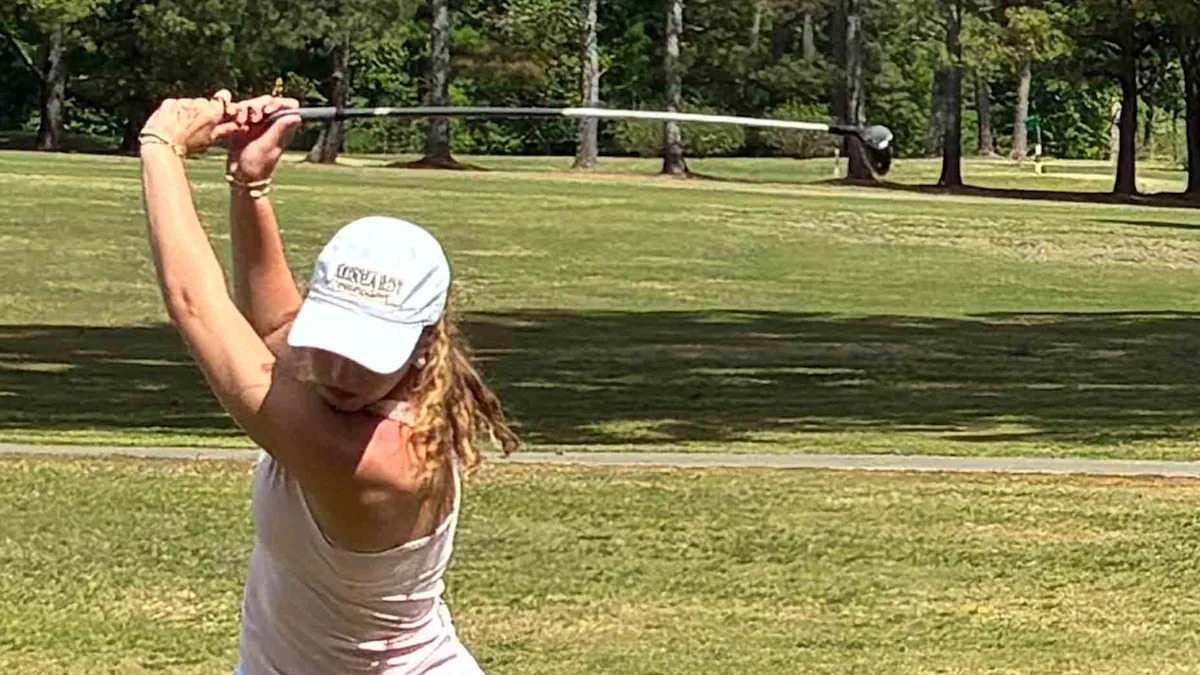
The new golfer brings the bottom of the new-to-her object close to her face and tilts it at a 2 o’clock angle, examining it curiously, before extending it toward a nearby onlooker.
“Is this one right?”
Advertisement
It’s a 4-hybrid club, which the new golfer discovers after being shown its marking. That’s good to know, and it seems correct, but that also depends, especially when you’re a new golfer.
I’d hit whatever feels best.
“OK, thanks,” says Jenna Smith, who goes with the club, and her ball wanders off to the right, dodging a few trees along the way.
The college golfer then does it all over again.
And again.
Her scores are out there, but keep scrolling. Two weeks after this practice session, at her school’s most important meet of the year, the NAIA-level Appalachian Athletic Conference conference tournament, there were 12s, a 13, some 14s and a 21. After three rounds, Smith finished with a 511, 295-over-par at Governors Towne Club in northern Georgia, and 289 strokes behind the winner. How she got there isn’t complicated. Her school, Reinhardt University, also in northern Georgia, had been down to three women’s golfers, four are needed to field a team, a note went out to Reinhardt’s other teams, and Smith and a few of her volleyball teammates were in. What’s the worst that could happen?
Advertisement
How about finishing worst?
Was she ready to put herself out there like that? Was she prepared to be embarrassed? She’s really, really good at volleyball, and really, really competitive in just about everything she does, so could she handle being really, really bad at golf?
What if a golf website heard about her story and chose to put her score in the big, bold words that everyone can see? 295-over par at a college event?
But look at the second part of that headline above.
Here’s the uplifting story behind it.
But maybe not initially. Samantha Roper, Isabella Mobley and Addy Anderson would’ve concurred to that, after their women’s golf coach, Evans Nichols, first told them they’d be joined by volleyballers. He could’ve entered the trio as individuals in events, foregoing a team score, but Nichols said the NAIA sours on that, though his solution wasn’t welcomed, either. His players seemed, well …
Advertisement
“To be frank,” Nichols said, “they seemed pissed.”
Addy?
Maja Brodzinska is a member of the Reinhardt University volleyball team. And the golf team. Nick Piastowski
“My first thought was: This isn’t good,” she said.
“This is not embarrassing for our program that we’re bringing in somebody that doesn’t know how to play golf and we’re playing the college sport, but just like, could we not find somebody else?”
Smith had played once before, just nine holes, and she thinks she shot 200. Maja Brodzinska, a volleyball teammate, had previously played for an hour, then played two days for Reinhardt in early March. The weeks leading up to that felt like a midterm cram session, only in this case, you never went to class all semester and the material was written in something akin to Martian. The instruction? Buffet style, as in here’s everything, but eventually you may get stuffed. During one practice round, Brodzinska worked on basics on the practice green with assistant Debbie Blount — in between nines. No one believes in Reinhardt and its women’s golf team like Blount, who, five years ago, joined the team — as a 62-year-old freshman. “She asked me the first time, she said, ‘What is the thing that you put the ball on?’” Blount said. “I said, ‘The tee?’ She said, ‘Oh, tee, tee.’ She said, ‘I don’t have any of those.’” Or anything. Blount gave Brodzinska her clubs; Smith was given a set that had been donated to the school a couple of years ago.
Advertisement
Brodzinska’s tournament came.
She shot a 204, 132-over par.
The next day, she shot a 172, 100-over. Progress. She took photos.
But a few weeks later, she needed to go back home, to Poland. Smith was called on, for conference of all places. On the first tee, she said a prayer. Smith does that. Back in late December, she did, and it had to have been heard. How else can you explain her asking to feel a little more unpredictability, and the golfer upstairs gives her tee times? “I want to be in uncomfortable situations as I’m getting older,” Smith said. “I crave uncomfortable situations because I know that’s going to push me to think about things, talk to different people. Think about how I’m going to get through it. And so it is very nerve-wracking, and it is uncomfortable, but it’s very exciting, and it’s something that every day I’m like, ‘Ooh, I don’t know how the next day is going to go.’”
Advertisement
Or her tee shots. Why the prayer on the first hole?
On the range at conference, her driver had been going right.
“No one knew why,” Smith said. “Coach was like, ‘I don’t know why. The swing looks great. The head face is turning the right way. I don’t know what’s going on.’ And so I was like, ‘Dear Lord, please don’t let this ball go to the right.’ I was literally sitting there thinking that the whole time.
“And I swung and it went to the right. And that just made me so angry.”
On the first hole, she made an 8. Then a 12. Then a five; hey, that’s a double bogey. Then a 21; that’s a septendecuple bogey. Or a lot. Whatever, she thought. She finished. It became a game. Finish holes, then better them in the next round and the round after that, especially that fourth hole. “I knew that I was going to have to do the same thing tomorrow,” Smith said. “And if I wanted to get better at tomorrow, then I had to finish it today at least.
Advertisement
“And then I ended up — I remember I counted specifically because this hole was so annoying. I got it in 11 strokes the next day. And then the last day, I got it in seven. So I was so happy about that.”

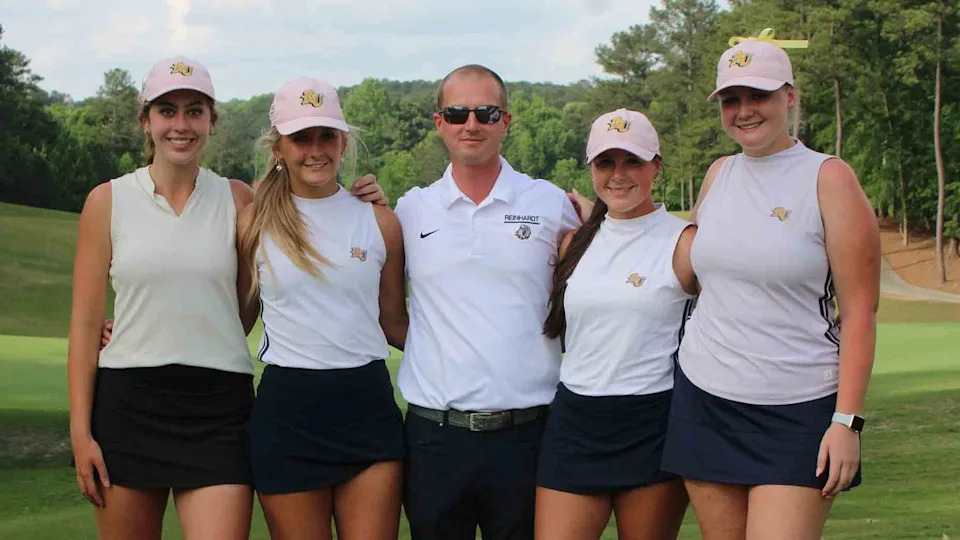
From left, Jenna Smith, Isabella Mobley, coach Evans Nichols, Addy Anderson and Samantha Roper. Debbie Blount
This, too.
Afterward, she learned her teammates tried to guess what she’d shoot. The number was 185.
Smith shot 184.
Then 167 in round two.
Then 160 in round three.
“And so I was like, ‘Hmph.’ So we got the scores in,” Smith said.
“And I got 184. Boom, boom. I beat everyone’s bets.”
She laughed. The question is, could her teammates have done what she did?
Thought of another way, could the golfers have, say, played volleyball, if the Reinhardt volleyball team had been in a similar bind?
Advertisement
Maybe now, following Smith and following Brodzinska. Maybe there’s beauty in 295-over par. It’s better than a zero. You started, you finished and then you returned wanting to shoot 294-over, which is what golf is all about, ain’t it?
If not more than golf.
295-over par at a college event?
Here’s the uplifting story behind it.
“One of the things that I’ve tried to take out of this whole experience for volleyball is the sport is not you. You are so much more than the sport,” Smith said. “And after this is all over, it’s not going to matter.
“I’ve talked to one of the girls on the team about that. She was beating herself up and I was like, you know, your score is not who you are. You’re more than that. You have so many qualities that just aren’t bound by golf. And I have to tell a lot of the girls on the volleyball team that as well, because it’s the same thing. It’s the same mindset.
Advertisement
“Even I have to remind myself at the end of the day, if I have a bad game. I am so much more than this sport. And this sport doesn’t last forever.”
Neither did Smith’s driver, the club she kept hitting right. She ditched it after the first hole. A few other clubs, too. She finished with a putter, a wedge, a 7-iron.
And that 4-hybrid.
They felt best.
They’re also getting new grips soon. Smith’s just a junior, after all.
Spring golf is only a year away.
The post 295-over par at a college event? Here’s the uplifting story behind it appeared first on Golf.
Read the full article here


