




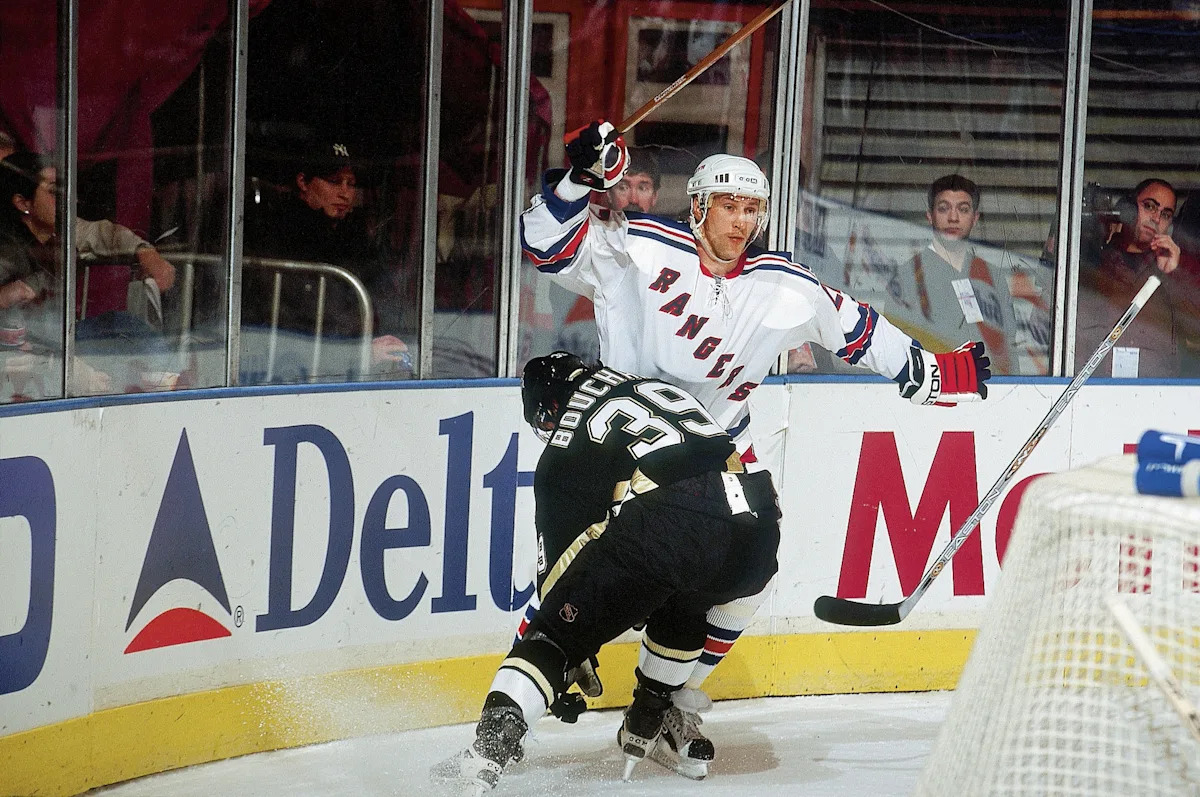
Memories like these pop up and serve as a reminder of how drastically different things were for the Pittsburgh Penguins, although now way in the past.
In some ways, this moment might have been – if not rock bottom – than certainly a ‘it always gets darkest before the dawn’ for the Penguins. Kovalev was sent off for most importantly what was termed “future considerations”, which meant $3.9 million dollars in cash. That was the biggest amount the NHL would allow to change hands on a trade in a season where the Penguins were expecting to lose money that year, making their already tenuous financial situation that much worse. The Pens also threw in relatively expensive veterans Laukkanen and Wilson to drop even more salary while picking up a hodgepodge of players back from the Rangers without receiving any of their best prospects.
Advertisement
It was an act of survival and desperation in a hockey landscape where the end result of a healthy Penguin franchise was far from a given. At this point there was no Sidney Crosby or Evgeni Malkin (or even Marc-Andre Fleury), there was just the grim financial reality of trying to scrape by and live to see another day. There was no reason to hope things would improve in the future, after all how could a team losing money purge their best players and expect to ever get better while worsening the product and team? That was a vicious cycle started with the Jaromir Jagr trade of 2001 as the team went into a downturn on and off the ice that troubled their very ability to remain competitive.
Of course by now, the sale of Kovalev is water long under the bridge. It took just five years from this point in 2003 to where the Penguins acquired Marian Hossa in 2008 as a sort of a full circle moment where the small time operation had been transformed into something completely different. In retrospect, it’s amazing just how quickly that took place.
A lot happened to get there: a new CBA tied revenue to team player payroll, there was an agreement with the state for a new arena to be built that would allow the team to grow, the draft broke extremely friendly to add players like Fleury, Crosby and Malkin to inject new life and talent get to the point where the shoe was on the other foot. The Penguins were now the fully functional NHL franchise, spending to the maximum limits, a position they would remain financially accessible to be at to this day. There were no more budgetary constraints, the team never had to imagine trading away a prime aged Crosby or Malkin due to salary concerns or even bigger questions about the viability of their team.
And, of course, eight years after they shipped him away, in 2011 Pittsburgh would re-acquire Kovalev as a rental of their own for a playoff run in the ultimate full circle moment. What he came back to by then was different in every way besides the jersey colors and Mario Lemieux from when Kovalev left.
Advertisement
That bright future felt like an extremely unlikely scenario back in 2003, when the Pens were in the NHL in name but hardly as a true franchise capable to operate.
Read the full article here


