




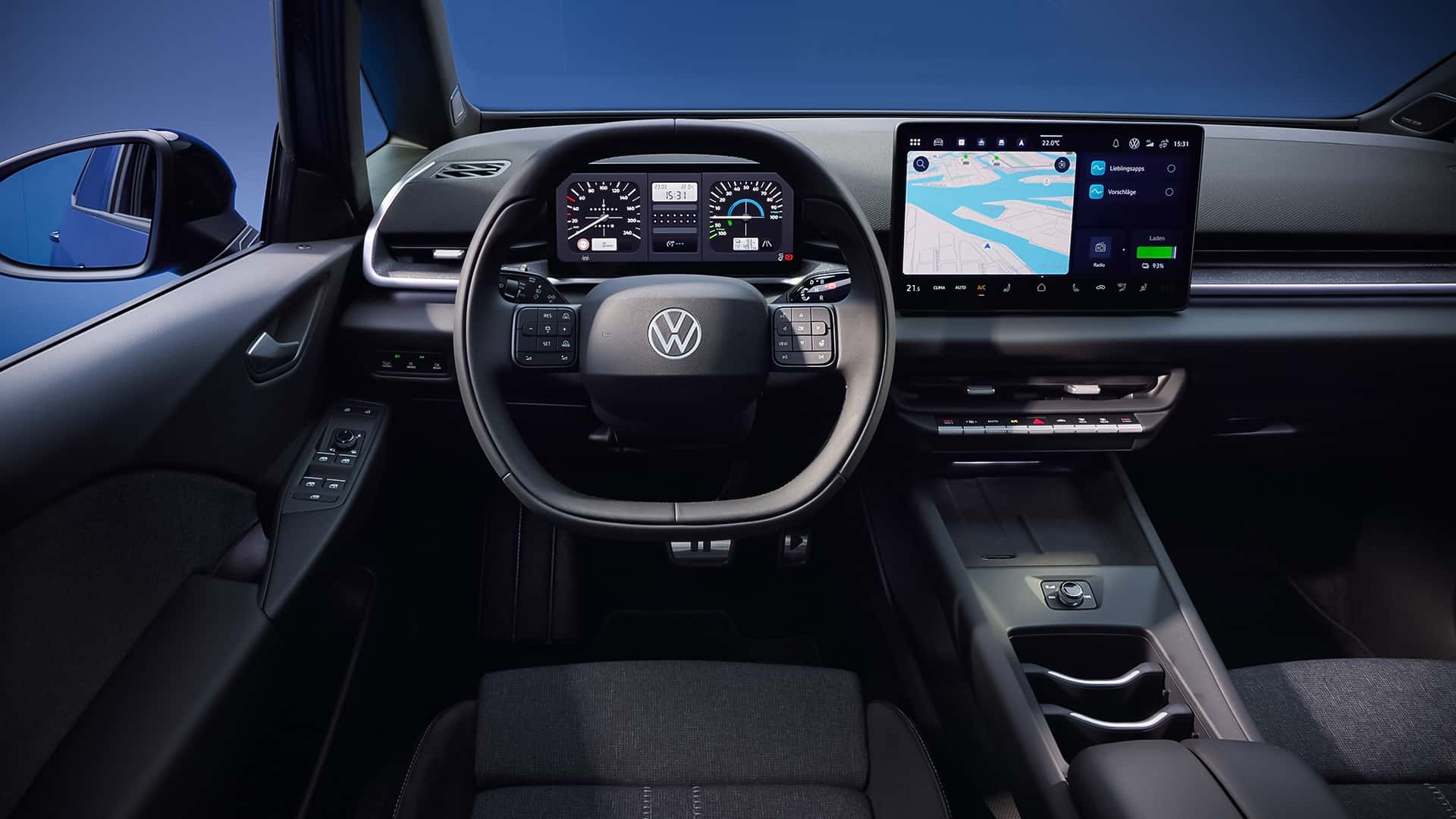
- The VW ID.3 Neo brings substantial improvements to the user interface.
- A new row of physical buttons provides shortcuts to climate settings.
- VW is adding dedicated rear window switches and a rotary knob.
- The ID.3 Neo also gets one-pedal driving and a vehicle-to-load function.
Volkswagen has been talking a great deal about how it’s listened to customer complaints about its simplified interiors and how it plans to fix past mistakes. It’s beginning to live up to that promise, as the 2026 ID.3 brings several key improvements to the user interface. While facelifted models typically come with fewer physical controls for the sake of cost-cutting disguised as minimalism, this electric hatchback thankfully bucks the trend.
Rebranded as the ID.3 Neo, the model’s revision ditches the dreaded touch slider used to adjust temperature and volume. VW could’ve saved even more money by fully integrating access to those functions into the touchscreen, but that’s not the case here. Instead, the center console has been redesigned to accommodate a row of physical buttons positioned below the air vents.
The strip of buttons on the center console provides quick access to temperature control, blower, air conditioning on/off, automatic climate mode, air recirculation, the windscreen defroster, and the rear window heater. It gets even better, as proper buttons can now be found on the steering wheel as well, replacing the capacitive touch keys of the pre-facelift ID.3.
2026 VW ID.3 Neo with physical buttons on the center console
Photos by: Volkswagen


2026 VW ID.3 Neo with four window switches
Another annoyance in the old version was the driver’s door panel, where dedicated switches for the rear windows were notably absent. For the ID.3 Neo, VW reverts to a familiar layout with four window switches, along with separate lock and unlock buttons. Everything is now where it should be, with a logical layout that hopefully other models will adopt.
There’s even more good news, as VW is installing a rotary knob between the seats. It’s not just for volume control but also for changing songs and stations via a track function. Practicality has also improved, with a lower storage shelf now located beneath the center console.
Another welcome change is the instrument cluster, which now measures 10.25 inches instead of the tiny 5.3-inch driver’s display used in the previous ID.3. It features retro graphics mimicking a late-model Golf Mk1, complete with an analog-style speedometer and rev counter. The latter obviously serves a different purpose since there’s no combustion engine; instead, it shows energy output and recuperation levels.
2026 VW ID.3 Neo front design
Photos by: Volkswagen
2026 VW ID.3 Neo rear design
The exterior clearly shows we’re dealing with a facelift rather than a true next-generation car. The ID.3 Neo is more of the same, but it does get redesigned headlights and a resculpted front bumper. Bisected by the illuminated VW logo, the horizontal light bar is noticeably thicker than before and sits beneath a glass cover. On higher trims, the bar lights up.
At the rear, the black tailgate has been replaced by a body-colored panel. Similarly, the windscreen surround, roof, and rear spoiler are now color-coordinated with the rest of the body. Since this is a facelift, the profile carries over unchanged, aside from some new wheel designs.
Unlike the upcoming smaller and cheaper ID. Polo with front-wheel drive, the ID.3 Neo sticks with its rear-wheel-drive underpinnings. It uses the latest MEB+ platform and comes with three battery options: 50 kWh, 58 kWh, and 79 kWh. Depending on the pack, the electric motor produces 168 hp, 188 hp, or 228 hp, respectively.
2026 VW ID.3 Neo profile design
Photo by: Volkswagen
While the largest battery supports DC charging at up to 183 kW, the smaller ones are limited to 105 kW. On a full charge, the ID.3 Neo with the 50-kWh pack is rated at 259 miles (417 kilometers), according to VW’s WLTP estimates. The 58-kWh version increases range to 307 miles (494 kilometers), while the 79-kWh model tops out at 391 miles (630 kilometers). Depending on the battery, it takes about 26 to 29 minutes to DC charge from 10 to 80 percent.
New for the facelift are one-pedal driving and a vehicle-to-load function. The latter effectively turns the ID.3 Neo into a power bank for external devices, although it requires an optional adapter. Another extra-cost feature is Connected Travel Assist, an evolution of VW’s driver assistance system that can automatically stop the car at a red light.
The ID.3 Neo goes on sale across Europe this month, with deliveries scheduled to begin in July.
39
Source: Volkswagen
Motor1’s Take: VW has addressed most of the criticism surrounding the previous ID.3. The Neo revision brings meaningful interior improvements while giving the front fascia a sharper look. Whether the more user-friendly interface will translate into higher sales remains to be seen, given the intense competition in this segment, especially from Chinese brands invading Europe.
Looking ahead, the ID.3 Neo is living on borrowed time. In case you’ve missed it, VW has already teased the ninth-generation, electric-only Golf. Reportedly called the ID. Golf, it’s launching before the end of the decade as a replacement for the ID.3. Given the improvements to the Neo’s interface, expectations are high for the return of an electric Golf.
Personally, I strongly believe that a Golf Mk7 with the latest battery technology would be the perfect EV in the compact class, but I’m afraid we’re past peak Golf.
Read the full article here


